


The Long Chu Festival in Hoi An: A Spiritual Ritual and Cultural Experience in the Heart of the Ancient Town


Hoi An is not only appealing because of its moss-covered Ancient Town and the small alleys lit by lanterns, but also because of its system of deep-rooted folk festivals. Among them, the Long Chu Festival stands out as an ancient ritual closely tied to the life of the residents along the Thu Bon River. This is a moment when the entire community gathers to build the boat, make offerings, parade the deities, and drive away evil spirits (or "ta khi" - dark energy).
1. Origins, Significance & Symbolism of the Festival
Amidst the ancient ambiance of Hoi An, the Long Chu Festival appears as a ritual that is both mysterious and familiar, combining folk belief and traditional craftsmanship. To fully understand the festival, one must start from its formation history, spiritual beliefs, and the symbolism of the Long Chu boat itself.
1.1. Historical Background and Community Traditions
The Long Chu Festival has long-standing origins in the culture of the residents of the lower Thu Bon River—a region where agriculture and fishing flourished but was also greatly affected by epidemics, ill-winds (or "on khi" - infectious diseases), and natural disasters. Very early on, the villages around Hoi An organized this ceremony according to the lunar calendar, often after the harvest or on important village occasions.
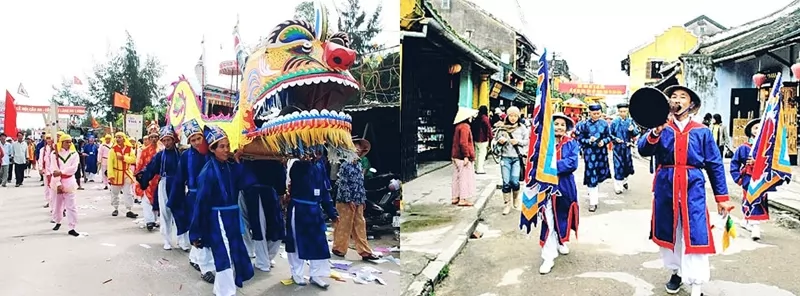
A unique aspect of the festival lies in its community spirit: from building the boat, decorating, offering sacrifices, to the procession itself, the work is done together by the villagers, elders, spiritual masters, artisan guilds (phường thợ), and youth. This formed the tradition of "the whole village performs the ritual," a distinct cultural feature of old Hoi An.
1.2. Spiritual Belief, The Long Chu Boat in Folk Faith
In Vietnamese folk belief, "long" means dragon, and "chu" means boat—symbolizing the imperial dragon boat. The ancients believed that the dragon was the supreme sacred animal, representing the power of heaven and earth and the protection of the gods.
The Long Chu boat, therefore, carries a strong spiritual symbolism:
- It is the means to "carry" ill-winds and epidemics out of the village.
- It is the place where deities, divine commanders, and spiritual armies rest while "on patrol" sweeping away bad omens.
- It is a symbol of the imperial court's power that protects the villagers.
No other festival in Quang Nam has such a distinctive spiritual-mystical color as the Long Chu Festival.
1.3. Artistic Craftsmanship Value of the Festival
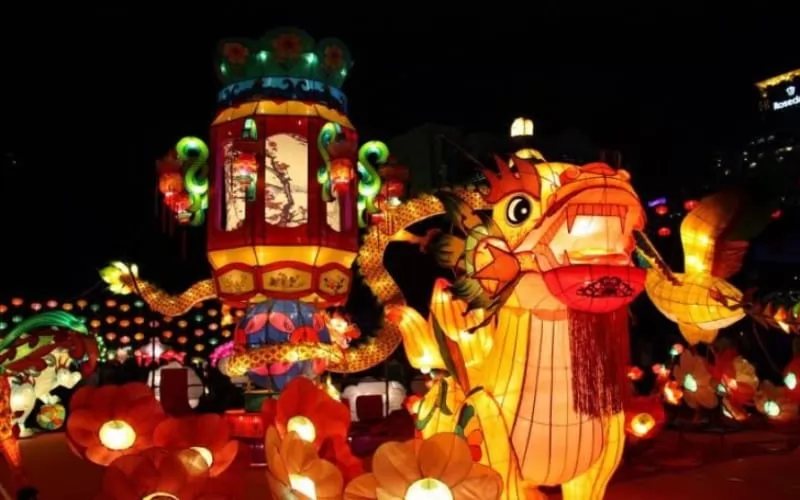
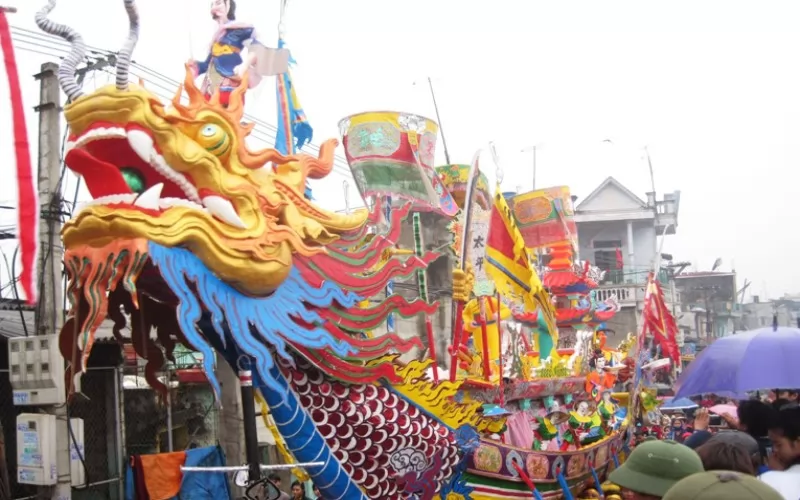
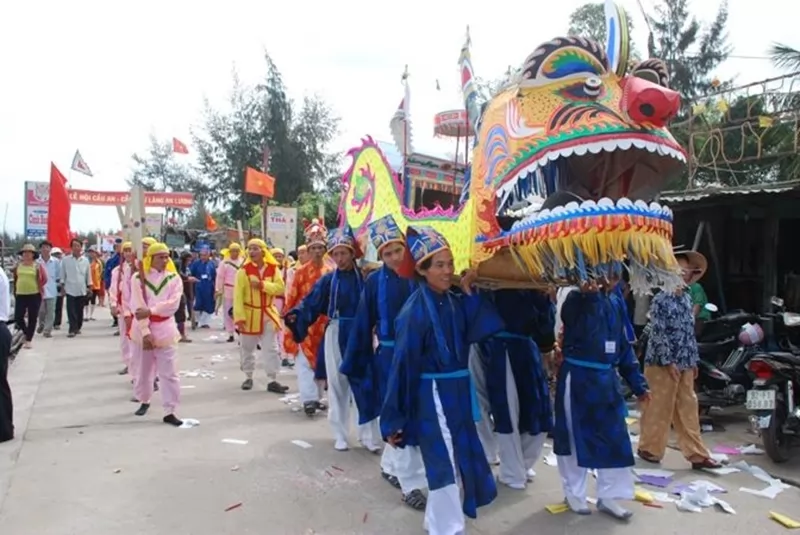
The Long Chu boat is made entirely by hand, showcasing the sophisticated skills of Quang artists. The frame is woven from bamboo, covered with paper or fabric, painted in bright colors, and adorned with a dragon head and phoenix tail, motifs of long-lân-quy-phụng (dragon-unicorn-tortoise-phoenix), flags, banners, and incense burners.
The making process lasts many days, becoming an opportunity to pass on the craft to the younger generation, contributing to the preservation of Hoi An's traditional craftsmanship.
2. Major Rituals in the Long Chu Ceremony
The Long Chu Festival is not just a cultural event but a tightly organized series of spiritual rituals, lasting for two days and two nights. Each ritual is a "link" connecting the religious life and the community's wish for peace and safety. This system of rituals clearly reflects the yin-yang worldview and the way Hoi An residents place their trust in the protection of deities and the collective's spiritual strength.
2.1. Preparations, Ritual Shielding - The Role of Spiritual Masters
Before the main festival takes place, the spiritual masters play a crucial leading role. They check the time and date (according to the lunar calendar), set up the incense altar, and identify spots believed to be places where "evil spirits gather" around the village.
During this stage, the spiritual masters will:
- Walk along the roads and alleys to cast spells and plant talismans.
- Lead a group of young people to clear trees and bushes, both tidying the village and building the festival atmosphere.
- Create a lively ambiance, signaling the upcoming day of the ceremony.
This is the "purification" step to clear the living space before moving into the more important rituals.
2.2. Deity Announcing Rituals, Offerings, and Praying Ceremonies
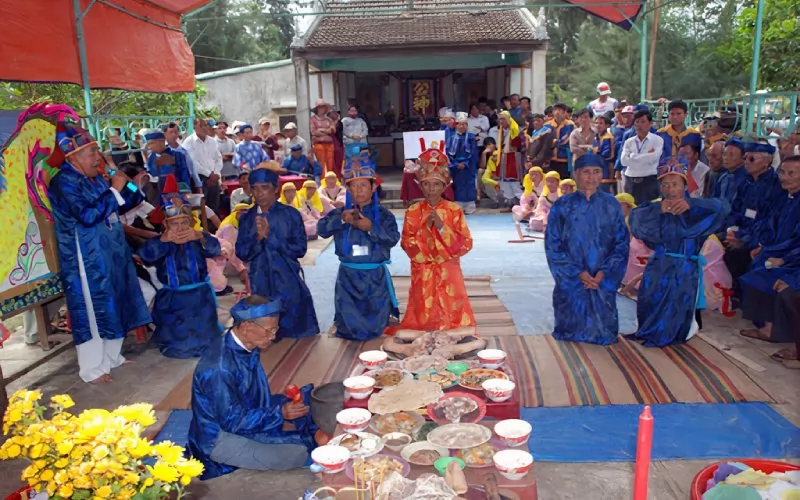
At the communal house —which is considered the spiritual center—the elders and the ritual committee perform a series of solemn ceremonies:
- Deity Announcing: Informing the Village Guardian Spirit and other deities about the day of the festival.
- Deity Offering: Offering incense, wine, and ritual items as a thank you and a prayer for divine acknowledgment.
- Praying Ceremony: Reading the ceremonial script, expressing the villagers' wishes for a bountiful harvest, good health, and peace.
This is the moment of connection between people and deities, between current life and age-old traditions.
2.3. Main Worship, Summoning Commanders and Spiritual Armies
After the Deity Announcing Ritual, the spiritual master continues to perform rituals with a very distinct mystical color:
- Chanting spells and ringing bells to "open the realm" and issue commands.
- Waving a wooden sword or striking a whip onto the ground to summon the divine commanders.
- Inviting the spiritual armies—the invisible troops—to come under their control.
In folk belief, the spiritual armies and divine commanders will board the Long Chu boat and join the deities to drive away evil spirits and epidemics.
2.4. Long Chu Procession - Parade, Fireworks, Protective Rituals
This is the most anticipated part of the festival. When the Long Chu boat has been dedicated to the deities, the procession starts from the communal house amid the sound of drums, gongs, and fluttering flags and banners.
The procession rituals include:
- The band, dance troupes, and village youth follow, creating an exciting atmosphere.
- People strike the ground with bamboo whips, symbolizing the act of chasing away evil spirits.
- Setting off firecrackers, cheering, and asking for protective talismans to bring home and paste on the front door for good luck.
The atmosphere of the parade is both solemn and lively, expressing the community's strong faith in the power of the deities.
2.5. Burning Ceremony - Purification, Boat Release to the River
As the Hour of the Pig (around 9 PM to 11 PM) approaches, the procession brings the Long Chu boat to an empty field or the riverbank to perform the final ritual:
- Burning the boat or releasing it to drift on the river.
- A cup of oil is placed on the boat as a lamp, symbolizing a guiding light to send the plague out to sea.
The moment the boat fiercely burns or quietly drifts away is seen as the moment of purification, restoring cleanliness and peace to the village.
3. Deep Meanings behind Each Ritual
The Long Chu Festival is not only a folk ritual; it is a system of ceremonies that deeply reflects how the Vietnamese perceive the universe, natural disasters, epidemics, and community strength. Each ritual—from the ritual shielding and deity announcing to the procession and burning of the boat—carries its own social and spiritual message, forming a clear journey of driving away evil and praying for peace.

3.1. Praying for Peace and Safety in the Community
Since ancient times, the residents of the Hoi An river region have constantly faced natural disasters, epidemics, and unpredictable changes. Therefore, the deity announcing, deity offering, and Long Chu worship ceremonies are always the most sincere prayers sent to the deities:
- Praying for peace and health for the entire village.
- Praying for favorable weather and a bountiful harvest.
- Praying to drive away the plague and epidemics—the worries that haunted the ancients.
The ritual helps people feel more at ease, brings a sense of protection, and strengthens their faith in life.
3.2. Unity of Villages - Resilience against Natural Disasters and Epidemics
The Long Chu Procession mobilizes almost the entire community:
- The elders take care of the offerings.
- The spiritual masters handle the spiritual rituals.
- The artisan guilds create the dragon boat.
- The youth, women, and children all participate in the procession and the games.
The fact that the whole village prepares and performs the festival together creates a source of solidarity—a "spiritual shield" that helps the community overcome epidemics and disasters. This is also an opportunity for generations to connect and preserve the customs and cultural traditions of the village.
3.3. Symbol of Virtue’s Triumph over Evil
The moment the Long Chu boat is burned—when the sacred fire flares up or when the boat quietly drifts away in the light of the oil cup—is considered the "conclusion" of the entire festival. This action means:
- Sending off all defilement, bad luck, and evil spirits.
- Symbolizing the triumph of light over darkness, of good over evil.
- Opening a new peaceful cycle, a bright new beginning for the community.
The sound of drums and joyful cheers after the ritual is a collective release—the feeling that all bad things have been "removed from the village," making way for good fortune and prosperity.
4. Festival Section & Traditional Folk Games in Hoi An
After the solemn rituals, the festival section of the Long Chu Festival opens up a lively and colorful atmosphere—a harmonious transition between spirituality and community culture. This is the time when all residents and visitors can immerse themselves in the vibrancy of folk art, traditional games, and the distinctive festival spirit of the heritage region.
4.1. Folk Games: Classical Theatre, Boat Song (Hp Khoan), Bamboo Racing (Xo Co)
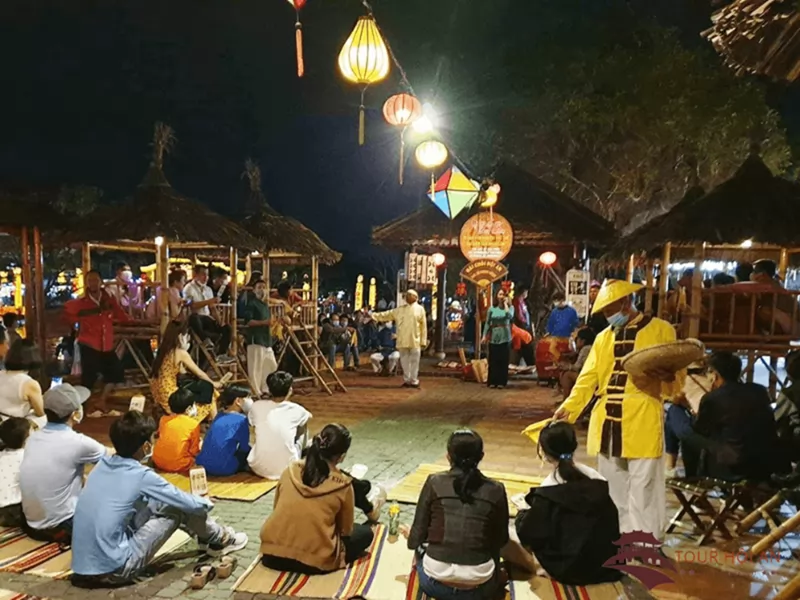
The festival section of the Long Chu Festival is an "outdoor stage" for the folk arts of Quang land to shine:
- Hat Boi (Classical Theatre/Tuồng): Classical plays about loyalty, filial piety, integrity, and righteousness are performed with bright costumes, stylized movements, and distinctive musical accompaniment. This is both art and a lesson in morality for the next generation.
- Ho khoan (Quang Nam Boat Song): An improvisational, witty, and lyrical style of call-and-response singing, often heard while people work or during festivals. The rhythm and lyrics create a simple and intimate atmosphere.
- Xo Co and folk games: Physical games tied to rural life that help young people test their strength, creating joy and community bonding.
Thanks to these activities, the festival section is both entertaining and preserves cultural values that are gradually fading.
4.2. Vibrant Atmosphere - Unique Festival Colors
When night falls, Hoi An is immersed in the light from lanterns, firecrackers, torches, and the costumes of the procession. The space becomes brilliant but still retains the sacredness of the traditional festival:
- Flags and banners flutter along the village roads.
- The firelight from the Long Chu burning ceremony creates a powerful visual effect.
- The sounds of drums, gongs, and the eight-tone orchestra blend with the laughter of the people.
All of this creates a truly unique "festival picture" of the Ancient Town—a mix of the sacred and the mundane, the ancient and the lively.
4.3. Opportunities for Visitors to Join, Experience, and Immerse
The Long Chu Festival does not exclude outsiders but welcomes all visitors to participate:
- Follow the procession to live in the flow of the festival.
- Join in playing bài chòi (a folk game), listening to folk songs, and watching Tuồng.
- Learn how the Long Chu boat is made—a rare experience elsewhere.
This is an opportunity for visitors to fully explore the local culture, not only to "see it once," but to immerse themselves in the religious life, art, and community of the Hoi An people.
>>> See more: Hoi An festivals and events: dates, traditions, and cultural highlights
Conclusion
The Long Chu Festival is a "living heritage" that symbolizes the spiritual soul and cultural solidarity of Hoi An. Through sacred boat rituals and vibrant folk games, the festival serves to ward off misfortune while preserving the region's traditional values. This unique celebration offers a deep cultural immersion, making it one of the most essential experiences for anyone visiting the Ancient Town.
You may also like: A first-timer’s guide to things to do in Hoi An
-
Hotline: 1900 63 66 00
-
Press 1 For tickets
-
Press 2 For Customer Service
 Tra Que Vegetable Village's Cau Bong Festival - The Beauty of Heritage
 10 Must-Visit Wellness and Spa Resorts in Hoi An
Related news
.webp)
Hoi An Memories: 100% Attractive Ticket Prices - Latest Offers in 2026

Hoi An Day Trip: A Detailed Guide to Fully Exploring the Town in 2026

Top 20 Must-Visit Attractions in Da Nang You Shouldn't Miss
Latest news

Hoi An Memories Land Honored with the “Corporate Excellence Award” at APEA 2026

Don’t Miss October’s Featured Heritage Experiences : Discover Hoi An’s culture through traditional workshops.

MID-AUTUMN FESTIVAL AT THE TRADING PORT – A NIGHT OF MEMORIES, A MEETING OF FIVE CULTURES
.webp)
.webp)
Comment