


17 Famous Pagodas and Temples You Must Visit in Hoi An


Hoi An is celebrated not only for the golden tranquility of its Ancient Town but also for its rich spiritual landscape. The numerous pagodas and temples found here are vital to understanding the city's complex cultural identity, serving as much more than just places of worship. In this article, join Hoi An Memories Land as we explore the most prominent sacred pagodas and temples in Hoi An for your journey.
1. Explore the Spiritual and Cultural Heritage of Hoi An
Having endured numerous historical ups and downs, the pagodas and temples of Hoi An still retain their solemn, ancient beauty and dignity.
1.1 Why Pagodas and Temples are Essential to Hoi An’s History?
Hoi An’s pagodas and temples are more than religious centers; they are historical anchors dating back to the 17th, 18th centuries. Many structures were built as early as the 17th, 18th centuries, marking Hoi An's era as an international port, serving as vital community halls for foreign merchants (Chinese and Japanese). Besides, the pagodas, temples function as spiritual centers for honoring protector deities, hosting Buddhist festivals, and preserving deep traditions for generations of locals.
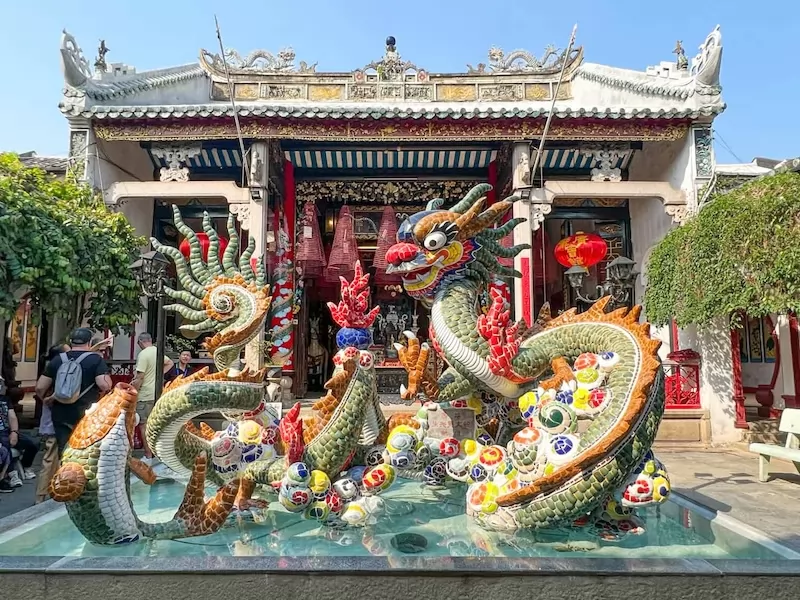
Pagodas and temples are essential to Hoi An’s history
1.2 Blend of Vietnamese, Chinese, and Japanese Influences in Architecture
The religious architecture is a stunning record of Hoi An’s multicultural past, featuring a rare convergence of three styles:
The religious architecture is a stunning record of Hoi An’s multicultural past, featuring a rare convergence of three styles:
Japanese Influence: Seen best in the Japanese Covered Bridge (Chùa Cầu), with its signature swooping, curved eaves and intricate details, marking it as a masterpiece of fusion.
Chinese Influence: Temples like Ong Pagoda and the Fujian Assembly Hall display a bolder aesthetic: vibrant red and green colors, massive tam quan gates, and ornate carvings reflecting Chinese deities and commercial traditions.
Traditional Vietnamese Aesthetics: Pagodas maintain a peaceful, harmonious style, featuring classic red tile roofs, meticulously carved wooden columns, and are typically nestled within green and airy environments, prioritizing a calm, contemplative space.
2. Top Pagodas and Temples in Hoi An
Each structure is a historical landmark, rooted in cultural fusion, history, and community faith.
2.1 Japanese Covered Bridge (Cau Pagoda)
The Japanese Covered Bridge owes its existence to the legend of Namazu, the mythical aquatic monster believed to stretch across India, Vietnam, and Japan, causing calamities whenever it moved. The bridge was erected by the Japanese community with the sacred purpose of acting as a symbolic sword pinning the monster down, thus preventing floods and earthquakes and ensuring peace for the people of all three regions. This profound, historical aspiration makes the bridge more than just a structure—it is a monument to peace.
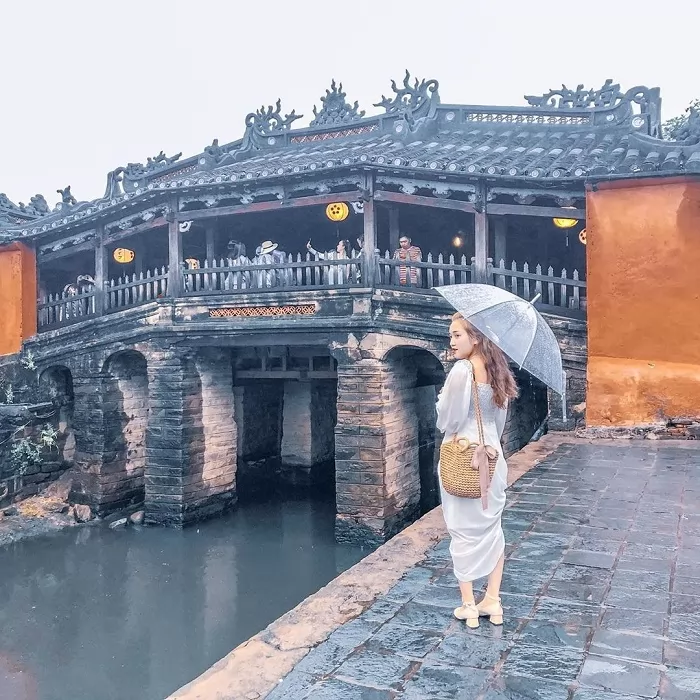
The Japanese Covered Bridge is one of Hoi An’s most famous check-in destinations
The bridge stands out as one of Hoi An’s most famous check-in destinations due to its unique appearance. It features a distinctive, softly curved roof that gracefully arcs like a rainbow, lending a touch of elegance and subtle modernity to the ancient townscape. Inside, the pagoda is unusual as it doesn't worship the Buddha, but instead venerates Bắc Đế Trấn Võ (Northern Deity Tran Vo), a guardian spirit. Guarding both entrances are statues of a dog and a monkey, completing its unique blend of Vietnamese, Japanese, and Chinese spiritual and architectural traditions.
Location: Đường Nguyễn Thị Minh Khai, Phường Hội An, TP. Đà Nẵng.
Opening hours:
- Morning: 9:00 AM - 11:00 AM
- Afternoon/Evening: 3:00 PM - 10:00 PM
Ticket Prices:
- 80,000 VNĐ per person for Vietnamese visitors.
- 120,000 VNĐ per person for International visitors.
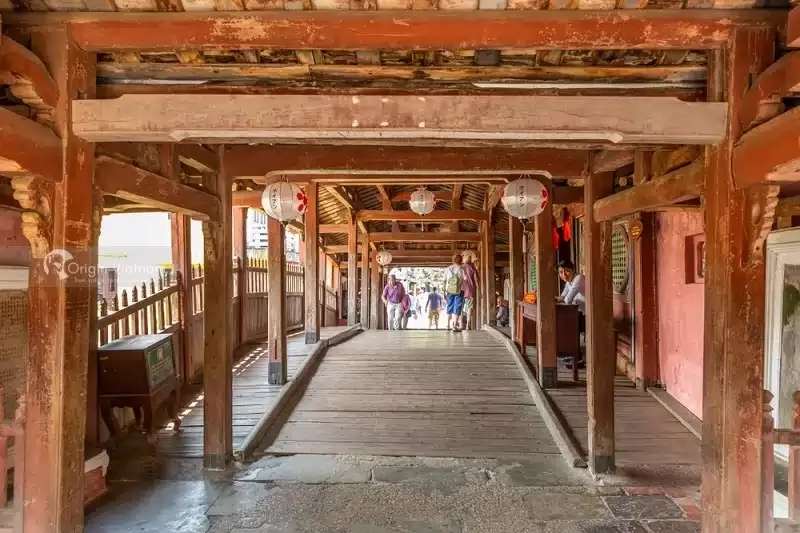
Inside the Japanese Covered Bridge
2.2 Quan Cong Temple (Ong Pagoda)
Quan Cong Temple (Ong Pagoda) was erected in the mid-17th century. venerates Quan Yu from the Three Kingdoms period, the symbol of loyalty, integrity, and courage. Historically, it was a crucial site where merchants pledged business agreements and sought luck. The temple was designated a National Historical-Cultural Relic on November 29, 1991.
Location: 24 Tran Phu Street, Hoi An Ward, Da Nang City
Opening hours: 6h00 – 17h00
Ticket Prices: Free
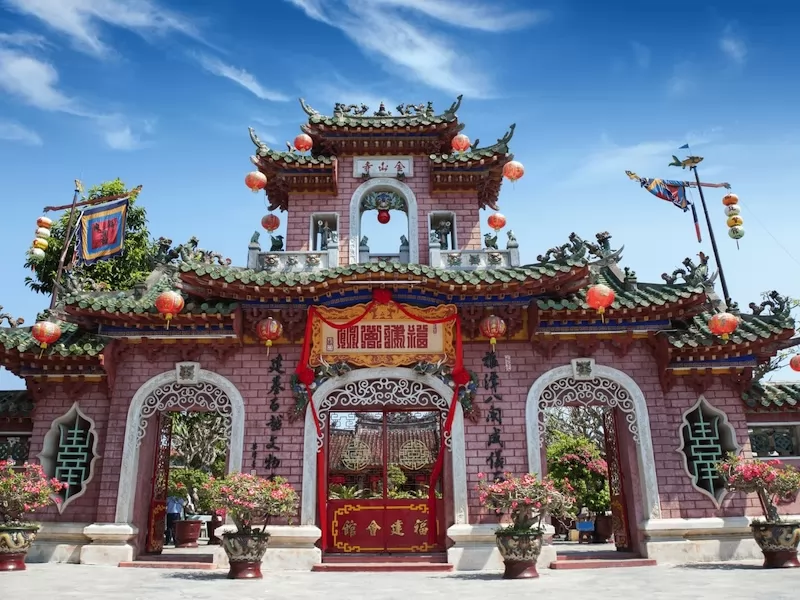
Quan Cong Temple
2.3 Quan Am Pagoda
Quan Am Pagoda (also known as Lady Buddha Temple or Minh Huong Pagoda) is a sacred site with origins potentially dating back before 1653, noted for its historical link to the Chinese monk Thich Dai San in the late 17th century. Locally, it is symbolically significant for its location near a bustling market, representing the close relationship between peaceful spirituality and noisy commerce. After serving various roles, including a small museum, it was fully restored to its function as a Buddhist temple in 2016.
The pagoda's entrance is marked by a modest, three-arched gate inscribed with Chinese characters reflecting core Buddhist concepts like 'emptiness' and 'absolute reality.' The main hall is used to honor a trio of Buddhas, with the Lady Buddha (Guan Yin) as the central saint.
Location: 13 Nguyen Hue Street, Hoi An Ward, Da Nang City.
Opening hours: 6h00 – 17h00
Ticket Prices: Free
2.4 Phap Bao Pagoda
Phap Bao Pagoda is considered a major Mahayana Buddhist center located in the heart of the Ancient Town, offering a serene retreat amidst the bustling atmosphere. The pagoda is impressively designed with a two-story structure, reflecting the traditional architecture of the ancient houses seen on Hoi An's streets. It serves as a key location where Buddhist courses and festivals are frequently organized, making it a peaceful and culturally significant place for prayer and spiritual learning.
Location: 7 Hai Ba Trung Street, Hoi An Ward, Da Nang city.
Opening hours: 6h00 – 17h00
Ticket Prices: Free
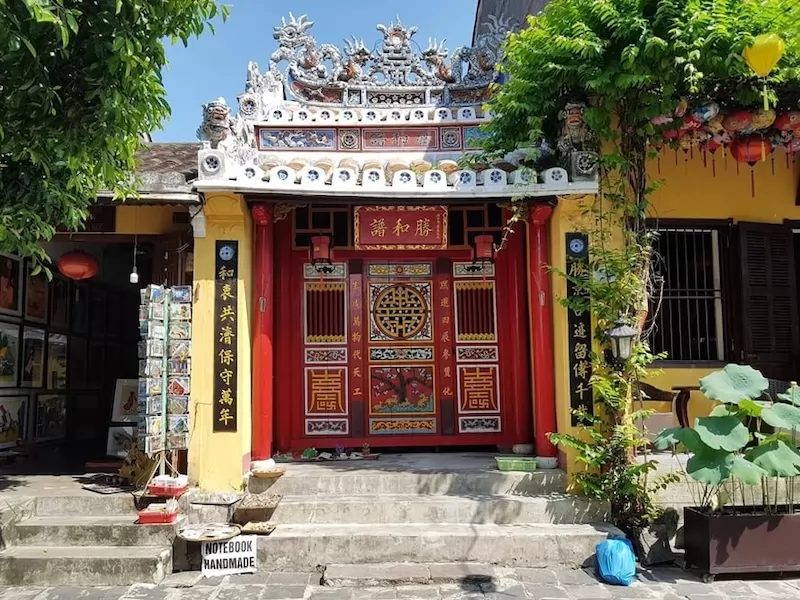
Phap Bao Pagoda
2.5 Ba Mu Temple
Ba Mu Temple's originally known as Cẩm Hà Palace and Hải Bình Palace, honors the Goddess of the Sea (Đức Thiên Hậu Thánh Mẫu) and the Twelve Midwives, then the temple's simplified name, Bà Mụ. The current structure is the result of a significant restoration project carried out by the city to rescue and preserve this important spiritual landmark for the local Minh Huong community.
The temple is now famous among young travelers as a must-visit "check-in" spot, primarily because of its beautifully restored Tam Quan Gate. The entrance features striking East Asian architecture, vintage color palettes, and is surrounded by a scenic lily pond and lush greenery, providing a perfect backdrop for photography.
Location: 675 Hai Ba Trung Street, Hoi An Ward, Da Nang City
Opening hours: All day
Entrance fee: Free
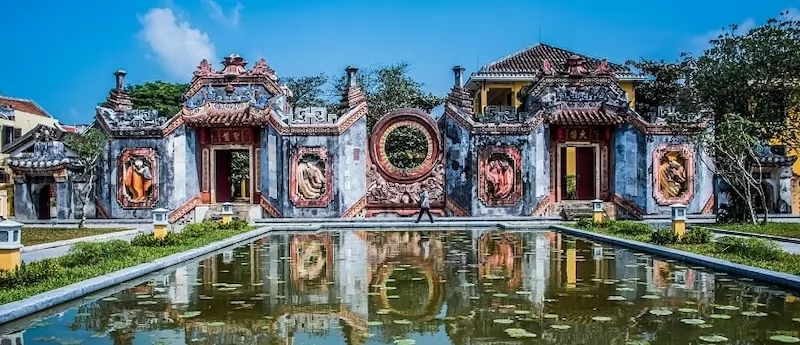
Ba Mu temple
2.6 Chuc Thanh Pagoda
Chuc Thanh Pagoda is the oldest pagoda in Hoi An, boasting a history of over 300 years. It was founded in 1687 by Zen Master Minh Hai from Quanzhou, China, who established the Lam Te Chuc Thanh Buddhist sect after attending a major Dharma propagation forum in Hue. The pagoda is characterized by its majestic yet ancient appearance, nestled beneath giant trees. The Tam Quan Gate is covered in moss and adorned with two intricately carved lions. The Main Hall has a sturdy truss system and a yin-yang tile roof featuring dragon and phoenix motifs.
This site carries immense spiritual and cultural value, hosting an annual commemoration for the founder, and it remains deeply linked to the spiritual lives of generations of locals.
Location: Area 7, West Hoi An Ward, Da Nang City.
Opening hours: All day
Entrance fee: Free
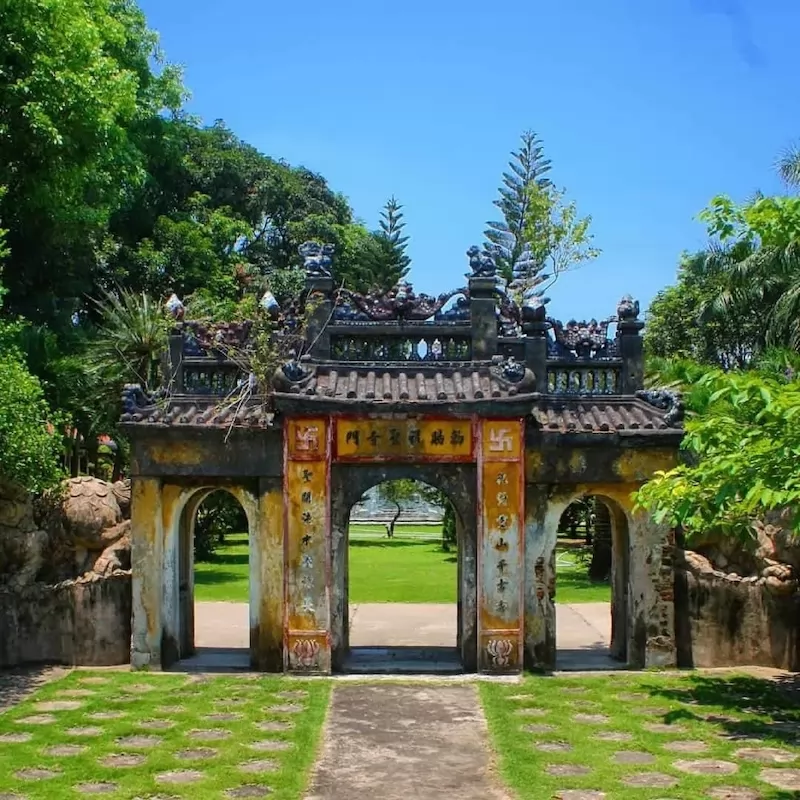
Chuc Thanh Pagoda
2.7 Phuoc Lam Pagoda
Phuoc Lam Pagoda is one of the most ancient and sacred pagodas in the Central region, with a history spanning over 300 years (built in the 18th century), dedicated to the worship of Buddha Shakyamuni, symbolizing enlightenment and compassion. It is an important site that marks the strong development of Buddhism in the area, founded by Venerable Minh Giang.
The pagoda's location is built on high ground with a large lake in front and sand hills behind, creating a cool, open landscape suitable for finding peace. Its architecture is typical of East Asian Buddhism, with traditional Vietnamese features like a brick three-door gate and a main hall topped with yin-yang tiles. The pagoda is a repository of many valuable antiques, including ancient porcelain bowls and woodblocks, reflecting its long history and cultural significance.
Location: Le Hong Phong Street, Cam Ha Ward, Hoi An.
Opening hours: All day
Entrance fee: Free
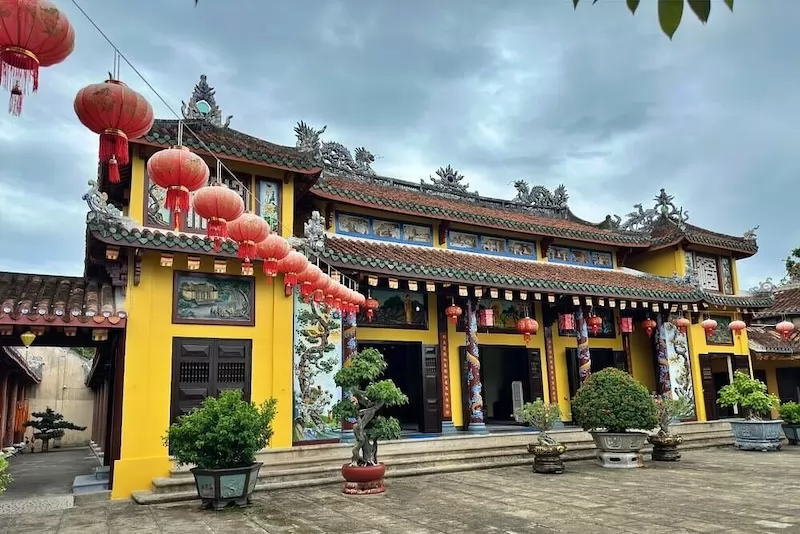
Phuoc Lam Pagoda
2.8 Van Duc Pagoda
Van Duc Pagoda is situated on a secluded, expansive piece of land along the right bank of the De Vong River, with origins dating back to a modest thatched hut built by Monk Minh Luong. The pagoda features a unique U-shaped architectural layout established by Abbot Hoang Nhon in the early 20th century, characterized by yin-yang tiled roofs adorned with motifs of dragons, lions, and phoenixes.
Van Duc Pagoda is renowned for its rich collection of valuable artifacts, including 115 antique wooden printing blocks used for reproducing Buddhist texts (some dating back to 1482 during the Lê dynasty), a large bronze bell, and ceramic items from the Ming and Qing dynasties. The pagoda's many gilded statues and extensive history make it a vital source for historical and cultural research, symbolizing the quintessential folk architecture of the region.
Location: Dong Na Hamlet, Cam Ha Commune, Hoi An.
2.9 Hai Tang Pagoda
Hai Tang Pagoda is the oldest Buddhist temple on the Cham Islands (Cù Lao Chàm), founded in 1758. Historically, the site was crucial for international merchants during Hoi An’s trading era, as their boats often stopped at Cham Island to pray for safe passage before navigating the Thu Bon River.
The architecture follows the traditional Vietnamese principle of water in the front and mountain in the back (facing rice fields with a stream, leaning against the mountain). Visitors are greeted by a large pond featuring a 3.5-meter statue of Lady Buddha (Goddess of Sea), who symbolizes safe travel. The pagoda was recognized as a Vietnam National Heritage site in 2007.
Location: Bai Lang Village, Cham Islands, Tan Hiep Ward, Hoi An.
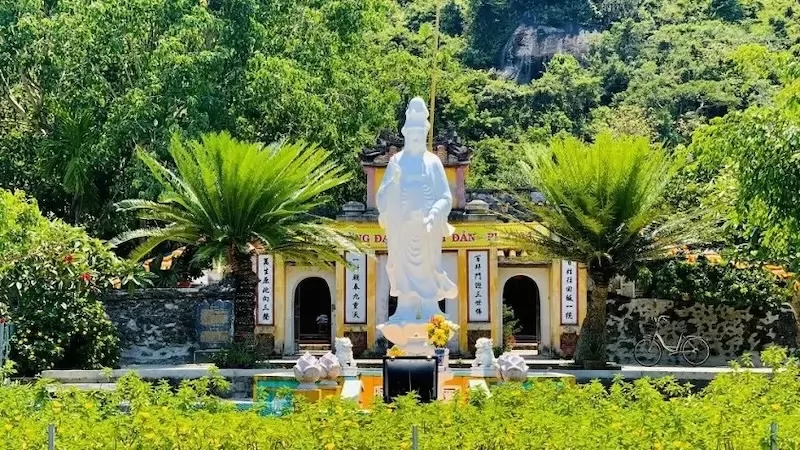
Lady Buddha statue in the Hai Tang Pagoda
2.10 Cam Pho Temple
Cam Pho Temple is one of the oldest communal houses in the present-day Hoi An area, with its village roots mentioned as early as the 16th-century geographical book Chau O Can Luc. The Communal House, which was moved to its current location near the Japanese Bridge due to historical floods, is dedicated to the worship of the Đại Càn Goddess (a deity related to water/river) and ten other deities.
The Communal House is architecturally distinguished by its three-entrance gate, the central Worshipping Hall with a pavilion featuring two roof layers adorned with phoenixes, and two side houses (East House and West House) used for communal meetings. It preserves 32 imperial sheets conferring titles to the gods, including 15 original documents.
Location: 52 Nguyen Thi Minh Khai Street, Cam Pho Ward, Hoi An.
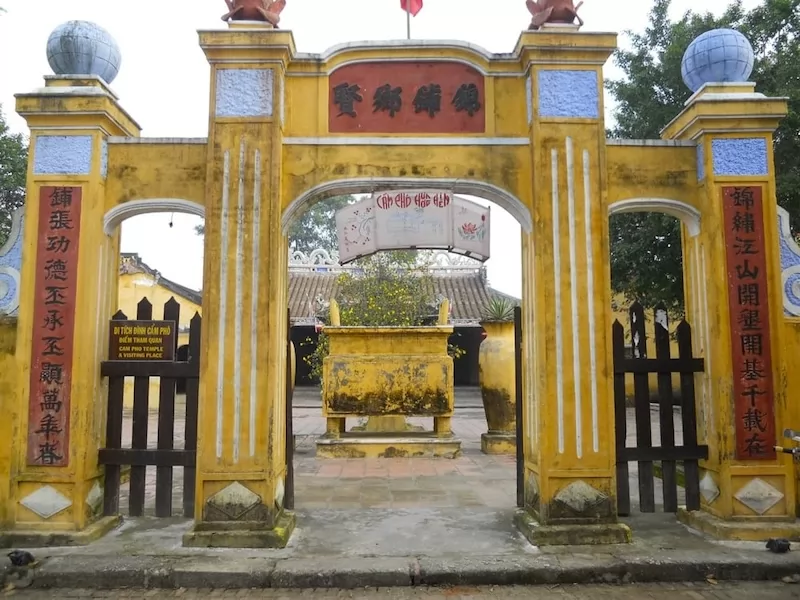
Cam Pho Temple
2.11 Fujian Assembly Hall (Phuc Kien Pagoda)
The Fujian Assembly Hall (Phuc Kien Pagoda) is a massive and impressive architectural work, first built in the 1690s. It was founded by Fujian migrants who settled in Hoi An after the fall of the Ming Dynasty. It was originally a thatched-roof Buddhist temple called Kim Son, which was bought by Fujian merchants and completely restored in 1759, renamed the Assembly Hall. The Assembly Hall has been recognized as a National Historical and Cultural Heritage since 1990.
The Assembly Hall mainly worships Mazu, the Chinese goddess of the sea, who protects sailors at sea. The pagoda covers an area of 2,000 square meters with a symbolic "Tam" (Tam) structure (front hall, main hall, back hall). The majestic three-entrance gate is built of bricks and tiles, decorated with statues of mascots such as dragons, symbolizing the harmony of "heaven-earth-human". The main gate is usually closed to avoid bad luck, while the left and right entrances are used, following the concept of "left male, right female".
Location: 46 Tran Phu Street, Hoi An.
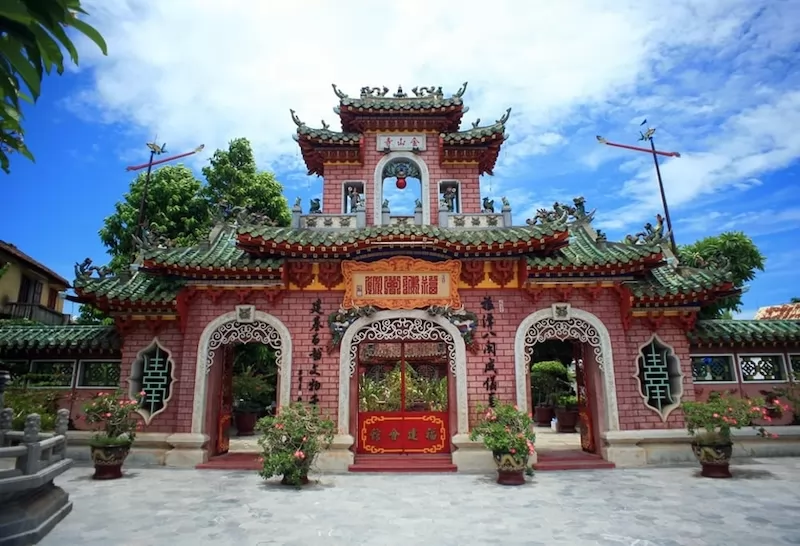
Fujian Assembly Hall
2.12 Cantonese Assembly Hall
The Guangdong Assembly Hall was built by Chinese people from Guangdong in 1885 to honor Confucius. However, since 1911, the worship has shifted to Guan Yu. The Assembly Hall was once an important community center for the Cantonese people, where meetings were held to support each other in business and daily life.
All the components of the Assembly Hall were manufactured in China, transported by boat, and assembled in Hoi An. The courtyard features a beautiful fountain adorned with a magnificent dragon statue, representing the legend of “Carp Jumping Over the Dragon Gate”. The assembly hall houses lacquer paintings and porcelain artifacts that testify to the history of the community.
Location: 176 Tran Phu Street, Minh An Ward, Hoi An.
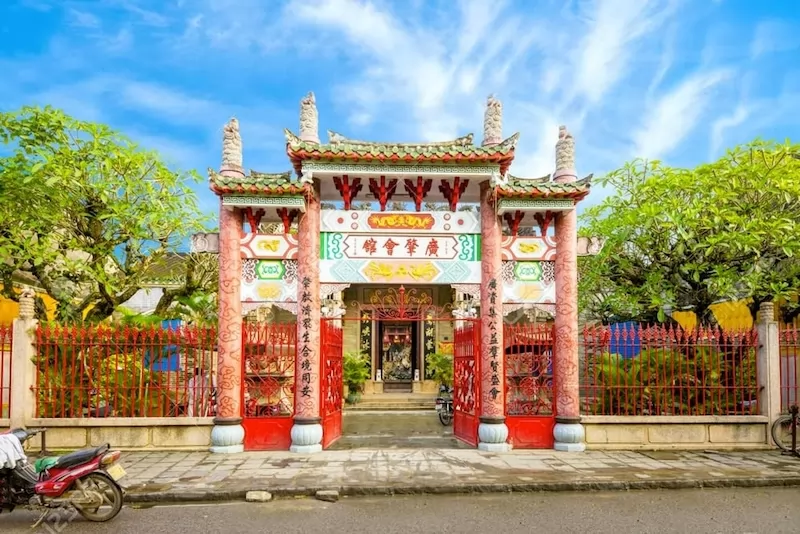
Cantonese Assembly Hall
2.13 Hainan Assembly Hall
The Hainan Assembly Hall was built in 1875 to commemorate 108 Hainan merchants who were mistakenly executed as pirates by local officials during the reign of Lord Nguyen Hoang. The assembly hall was posthumously awarded the title “Nghia Liet Chieu Ung” by King Tu Duc.
This is a deeply historical site that provides insight into the challenging legacy of the Hainan community in Vietnam.
Location: 10 Tran Phu Street, Hoi An.
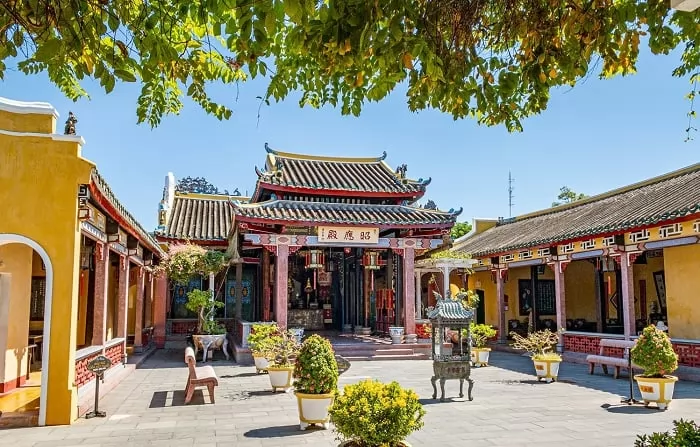
The Hainan Assembly Hall
2.14 Tran Family Chapel
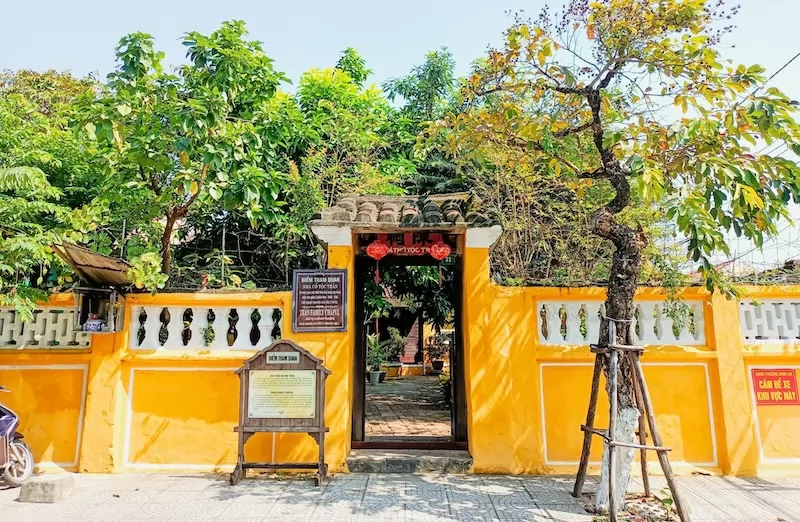
Tran Family Chapel
The Tran Family Temple was built in 1802 by Tran Tu Nhac, an intellectual mandarin under King Gia Long. He built the church to worship his ancestors before leaving for his mission to China. The large campus covers an area of 1,500 square meters, including a main church and a front garden.
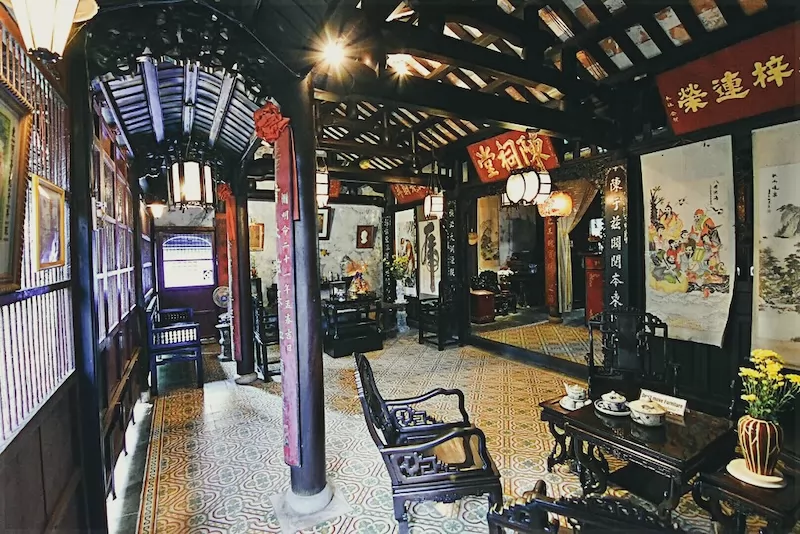
Inside the Tran Family chapel
The church's architecture is a unique blend of Vietnamese, Chinese and Japanese styles. The main gate faces west, symbolizing the direction of the ancestors. The chapel houses Tran Tu Nhac's sword, a genealogy book dating from 1812, Chinese ink paintings and ancient ceramics. The yellow wall of the church stretches along Phan Chu Trinh Street and is a famous and typical backdrop for photography in Hoi An. In the garden, there are small mounds where children's placentas are buried, meaning that the children will remember their homeland.
Location: 21 Le Loi St, Minh An ward, Hoi An
2.15 Vien Giac Pagoda
Vien Giac Pagoda belongs to the Northern Zen sect. The pagoda was originally a village pagoda called Cam Ly in Xuyen Trung, which was moved to its current location in 1841 due to riverbank erosion. The pagoda was officially recognized as a National Historical Relic in 1992.
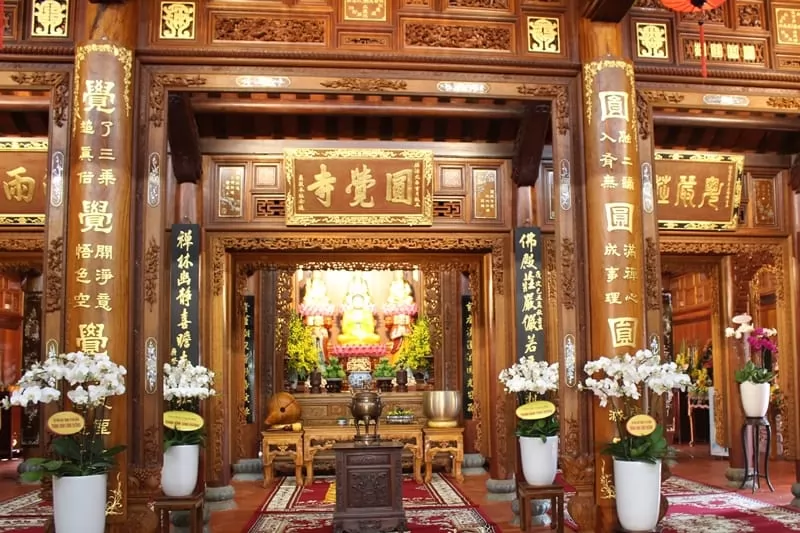
The main shrine of Vien Giac Pagoda
The pagoda's architecture is a harmonious blend of Vietnamese and Chinese cultural influences. The main shrine worships the meditating Buddha Shakyamuni, flanked by Bodhisattvas. The pagoda is surrounded by trees, providing visitors with a quiet space to seek peace and serenity, especially during major holidays such as Vesak and Vu Lan.
Location: 34 Hung Vuong Street, Cam Pho Ward, Hoi An.
2.16 Ong Bon Pagoda (Chaozhou Assembly Hall)
The Chaozhou Assembly Hall (or Ong Bon Pagoda) was built by the Chinese in Chaozhou in 1845, and is one of the five largest assembly halls in Hoi An. The original purpose of the assembly hall was to be a place for community activities and worship of the Chaozhou people, honoring the gods who could control the wind and waves, bringing peace and success in business.
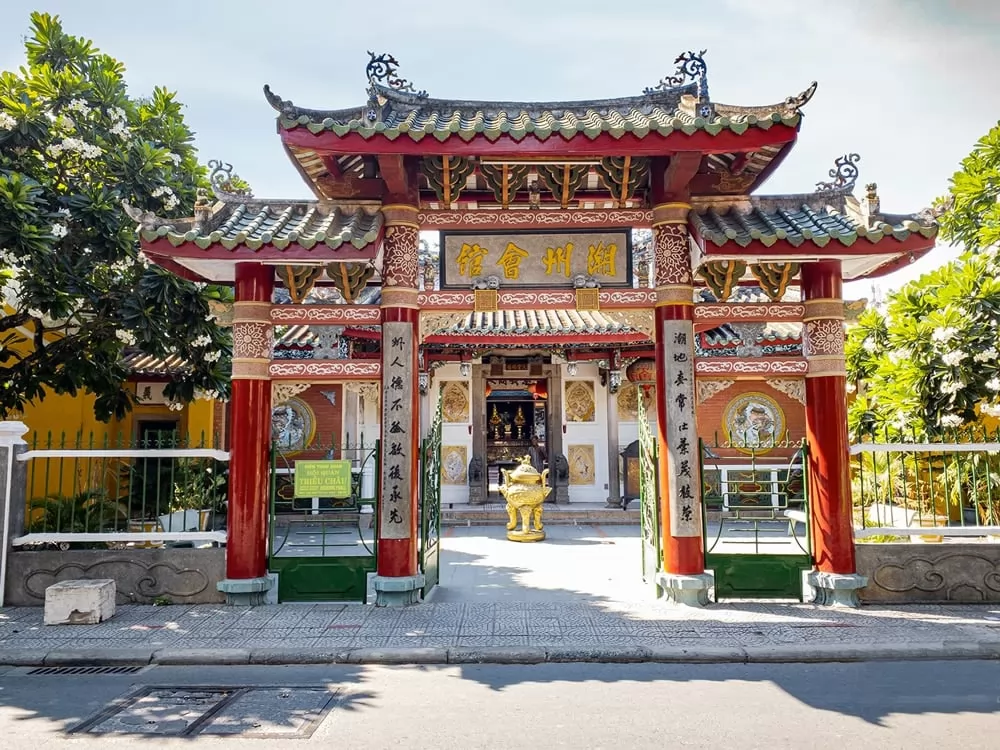
Chaozhou Assembly Hall
The facade is built from large stone slabs with elaborate carvings of butterflies, the four sacred animals, and carp transforming into dragons - all of which have profound meanings in Chinese culture. The main hall uses large wooden columns and has an architectural design with overlapping rafters, with the beams intricately carved with birds and mythical characters.
Location: 362 Nguyen Duy Hieu, Cam Chau Ward, Hoi An.
2.17 Kim Buu Pagoda
Kim Buu Pagoda, located in Trung Chau Village on Cam Kim Commune, is a sacred village temple that is intrinsically tied to the local spiritual life.
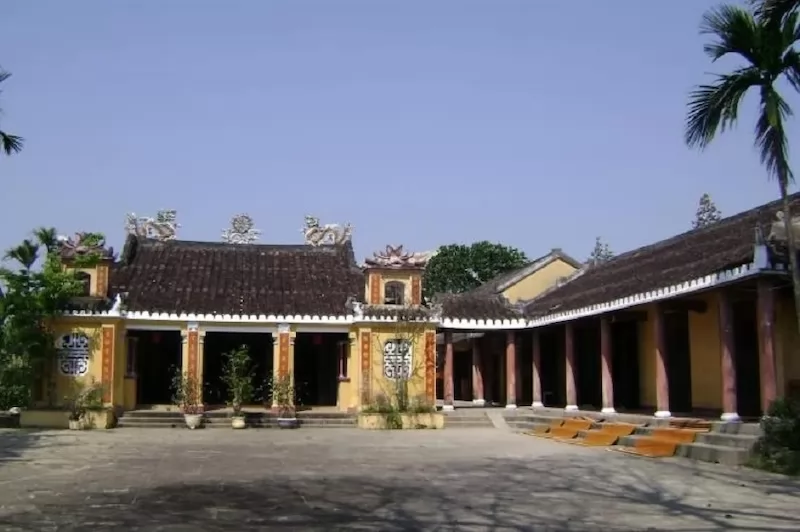
Kim Buu pagoda
During the Vietnamese resistance wars, Kim Buu Pagoda served as a crucial liaison base, sheltering and protecting leading officials of the Hoi An Town and Quang Nam Provincial Party Committees. It was the site of key meetings, including the re-establishment of the Provincial Party Committee in April 1944 and meetings to prepare for the General Uprising in 1945. Nowadays, beyond its traditional architectural value, the pagoda is recognized as a significant "red address" for educating future generations about the revolutionary tradition.
Location: Trung Chau Village, Cam Kim Commune, Hoi An City
From the iconic, rainbow-roofed Japanese Covered Bridge to the deep historical significance of Kim Buu Pagoda, these temples are not merely sites for spiritual worship but stand as crucial historical and cultural testaments to the urban heritage of Hoi An—a UNESCO World Heritage site. When visiting Hoi An, be sure not to miss the chance to explore these sacred sites (vãn cảnh chùa) to find inner peace and contemplate the unique spiritual life of the Faifo people. Follow Hoi An Memories Land to discover even more fascinating insights about Hoi An!
See more:
>>> Essential experiences for first-time visitors to Hoi An
-
Hotline: 1900 63 66 00
-
Press 1 For tickets
-
Press 2 For Customer Service
 The Whale Worship Ceremony - A Unique Cultural Tradition of Hoi An Fishermen
 How to travel to Hoi An from Hanoi? Schedule, ticket prices
Related news
.webp)
Hoi An Memories: 100% Attractive Ticket Prices - Latest Offers in 2026

Hoi An Day Trip: A Detailed Guide to Fully Exploring the Town in 2026

Top 20 Must-Visit Attractions in Da Nang You Shouldn't Miss
Latest news

Hoi An Memories Land Honored with the “Corporate Excellence Award” at APEA 2026

Don’t Miss October’s Featured Heritage Experiences : Discover Hoi An’s culture through traditional workshops.

MID-AUTUMN FESTIVAL AT THE TRADING PORT – A NIGHT OF MEMORIES, A MEETING OF FIVE CULTURES
.webp)
.webp)
Comment